


PSLE year can feel especially intense in a dual-income household. One parent is rushing from a morning meeting, the other is replying to messages on the MRT, and by the time everyone gets home, it is already close to dinner. In that kind of routine, PSLE preparation can quickly turn into another source of tension instead of a steady, manageable process. Many parents in Singapore are not short on care or commitment. They are short on time, energy, and mental space.
The good news is that effective PSLE preparation does not require a parent to sit beside their child for four hours every night. What it does require is structure, clear priorities, realistic routines, and the right support. For families where both parents work, a thoughtful plan can reduce last-minute panic and help your child stay consistent without burning out. This guide focuses specifically on how to manage PSLE preparation in a dual-income household, with practical systems that work in real Singapore family life.
Key Takeaways
- A successful PSLE study schedule for working parents should be simple, repeatable, and realistic enough to survive busy weekdays. If a plan only works on ideal days, it will usually fall apart the moment work runs late or your child comes home exhausted.
- Strong time management for PSLE students in Singapore often starts with shorter, focused study blocks instead of long hours at the desk. Consistency usually matters more than intensity.
- Balancing work and child exam preparation works better when parents divide roles clearly, rather than both trying to manage everything at once. Clear ownership reduces confusion and missed tasks.
- A stable home study routine for primary school students helps reduce daily arguments because expectations are already set. Children usually cope better when they know what each evening will look like.
- Practical parent support strategies for PSLE preparation, including tuition, check-ins, and weekly planning, can ease pressure on both parent and child. The right support should simplify the process, not make it more crowded.
- The goal is not to create a perfect household, but a sustainable system your family can actually maintain through the full PSLE year.
- Monday: Math practice and corrections. This works well after the weekend because your child can revisit mistakes from previous worksheets while concepts are still fresh.
- Tuesday: English comprehension or composition planning. If your child struggles with open-ended questions, use one passage and discuss two or three answers instead of forcing a full paper.
- Wednesday: Science revision. A tired midweek evening may be better used for topical review, such as cycles or systems, rather than a full timed paper.
- Thursday: Mother Tongue practice or weaker subject support. This helps prevent one subject from being ignored until the last minute.
- Friday: Lighter review. A vocabulary recap, error log check, or oral practice may be more realistic than a full assessment after a long week.
- Parent A manages the weekly timetable and tuition coordination. This includes confirming lesson times, checking for clashes, and making sure the week is not overloaded.
- Parent B reviews school updates, test dates, and error logs. This keeps revision aligned with what teachers are actually flagging.
- Both parents do a short Sunday check-in together. Even 10 to 15 minutes can help everyone reset and prepare for the week ahead.
- Review the past week’s mistakes. Spend 20 to 30 minutes looking through corrections, especially for repeated errors.
- Preview the coming week. Check school notices, spelling lists, test dates, and tuition timings.
- Prepare materials early. Print worksheets, file loose papers, and place the needed books in one spot.
1. Why PSLE Preparation Feels Harder in a Dual-Income Household
Dual-income families often face a very specific kind of pressure during PSLE year. It is not just about wanting good results. It is about trying to support your child while work deadlines, commuting, dinner, enrichment schedules, and household admin continue as usual. At 8.30pm, when your child still has Science corrections to do and one parent is still on a laptop, stress can build very quickly.
1.1 The hidden challenge is not care, it is coordination
Most working parents care deeply about their child’s progress. The problem is coordination. One parent may assume spelling revision has been done, while the other assumes Math practice is under control. By Friday, both realise nothing was properly tracked that week. This is why PSLE preparation in a dual-income home needs systems, not just good intentions.
For example, if your child has school until the afternoon, then student care or CCA, there may only be a narrow window between 7.30pm and 9pm for meaningful work. Without a clear plan, that window gets wasted deciding what to do, hunting for worksheets, or arguing over mistakes. A simple weekly structure protects that limited time and makes evenings feel less chaotic.
1.2 Why guilt often makes things worse
Working parents often carry guilt, and that guilt can lead to overcompensating. Some suddenly pack weekends with assessment books, extra papers, and long revision sessions. Others avoid pushing their child at all because they already feel bad about not being around enough. Both extremes can backfire.
A more helpful approach is to accept your family reality and build PSLE preparation around it. If weekdays are tight, make them focused and predictable. If weekends are more flexible, use them for deeper review. Your child does not need a parent who is constantly available. Your child needs a parent who is calm, clear, and consistent.
2. Building a PSLE Preparation System That Fits Working Parents
The best PSLE study schedule for working parents is not the most ambitious one. It is the one your family can still follow after a rough Monday, a late office call, or a child who comes home tired from school. A workable system should reduce daily decision-making and make studying feel routine, not dramatic.
2.1 Create a weekly rhythm, not a daily battle
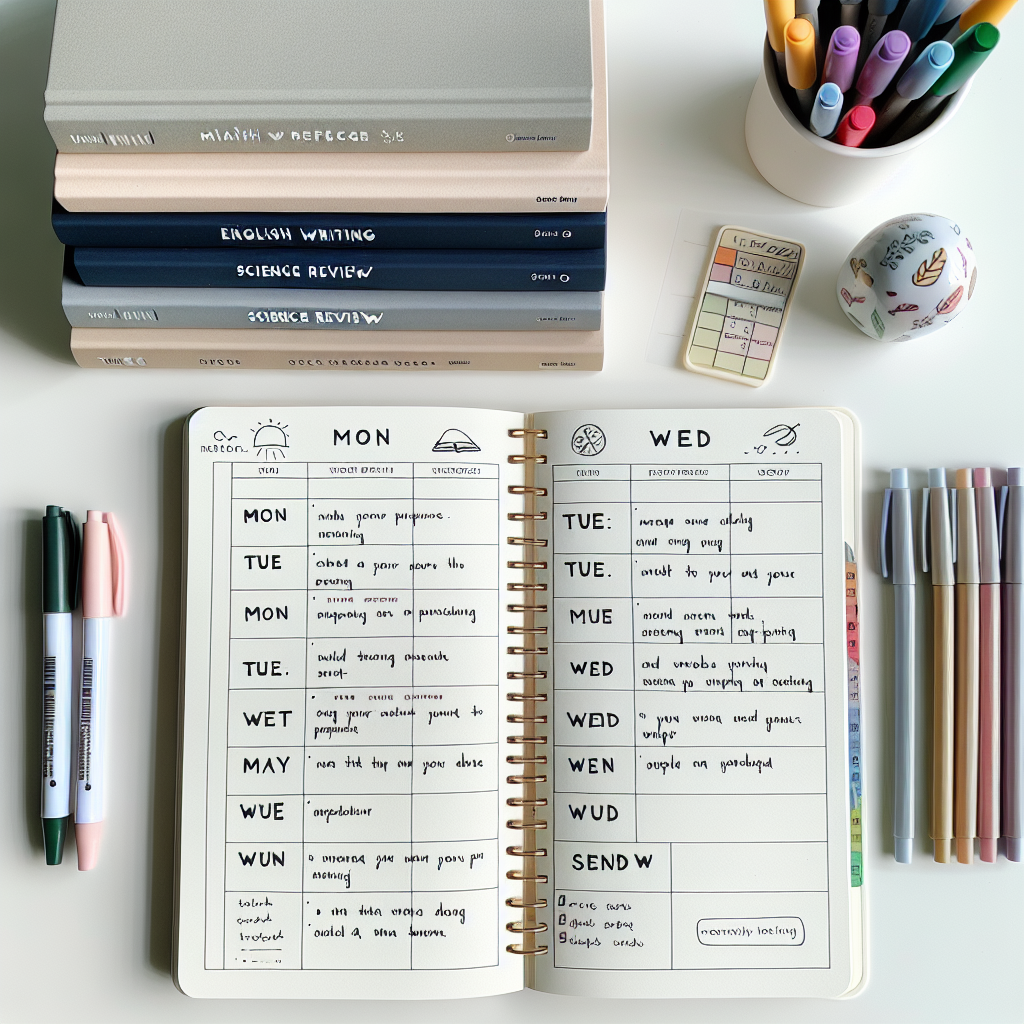
Instead of planning from scratch every day, assign broad subjects to fixed days. For example:
This kind of structure helps with balancing work and child exam preparation because everyone knows what each evening is for. It also reduces the emotional load of repeatedly asking, “What should we do tonight?”
2.2 Use study blocks that match your child’s energy
A common mistake is assuming serious PSLE preparation must mean sitting for two straight hours. Many Primary 6 students do better with 25- to 40-minute blocks, followed by a short break. A child who comes home mentally drained may still manage one focused Math paper section and one round of corrections, but not an entire night of revision.
This is especially important for time management for PSLE students in Singapore, where long school days are already tiring. Focused work, done consistently, usually beats forced marathon sessions that end in tears. If your child is especially tired on certain days, scale down the task but keep the routine. Even 30 minutes of useful revision is better than a two-hour struggle with very little retention.
2.3 Build in buffer time for unpredictable weeks
One reason many family study plans fail is that they leave no room for real life. There will be school events, surprise homework, parent overtime, and evenings when your child is simply not at their best. If every weekday is packed tightly, one disruption can throw off the whole week.
A practical fix is to leave one buffer slot each week. This can be Friday night, Sunday afternoon, or any period your family can protect. Use it for unfinished corrections, missed revision, or a quick catch-up on weak topics. Buffer time makes the system more forgiving, which is exactly what working households need.
3. Setting Up a Home Study Routine for Primary School Students
A predictable home study routine for primary school students is one of the most effective ways to reduce stress in a dual-income household. When routines are unclear, every evening becomes a negotiation. When routines are stable, your child knows what happens after dinner, where materials are kept, and what study time actually means.
3.1 Keep the routine simple enough to survive busy days
A good home routine does not need ten steps. It can be as simple as:
1. Snack and short rest after school.
2. Shower and dinner.
3. Study block 1.
4. Short break.
5. Study block 2 or corrections.
6. Pack bag and sleep.
The power is in consistency. If your child knows that 8pm to 9pm is always study time, there is less room for bargaining. This matters when both parents are tired. You do not want to spend precious evening energy debating whether revision should happen. The routine should answer that for you.
3.2 Prepare the study environment in advance
Working parents often lose time to small things. A missing Math file, an uncharged laptop for online school resources, or worksheets buried under old spelling lists can derail the whole evening. Set up one study corner with the essentials: stationery, correction tape, files by subject, and a visible weekly plan.
If your child reaches the table and everything is ready, they can begin in five minutes. If they need to search the house for a Science notebook while you are reheating dinner and replying to work messages, frustration rises quickly. A prepared environment supports better PSLE preparation because it protects the little time your family has.

4. Dividing Parent Roles to Make PSLE Preparation More Manageable
In many dual-income homes, both parents want to help, but unclear roles lead to overlap in some areas and neglect in others. One parent may handle emotional support while the other handles logistics, but if this is not discussed, things can easily fall through the cracks. Clear division of responsibility is one of the most practical parent support strategies for PSLE preparation.
4.1 Assign roles based on strengths and schedules
One parent may be better at checking written work, while the other is more consistent with scheduling. Use that. If one parent reaches home earlier, they can supervise the start of the evening routine. If the other parent is stronger in Math or Science, they can review corrections later or on weekends.
A simple division might look like this:
This helps with balancing work and child exam preparation because each parent knows their job. It also reduces the classic “I thought you handled it” problem that creates avoidable stress.
4.2 Keep communication short and practical
You do not need long family meetings every night. A shared note on your phone can be enough. Record what was completed, what needs follow-up, and what upcoming school tasks matter. For example: “Science topical revision done. Math fractions corrections not finished. English oral on Thursday.”
This is especially useful when one parent travels for work or comes home late. Your child still experiences continuity, which is important during PSLE preparation. They feel that the adults are aligned, even if both are busy.
5. Using Tuition Strategically in PSLE Preparation
For dual-income households that can afford it, tuition can be more than extra academic practice. It can provide structure, accountability, and targeted support that working parents may struggle to deliver consistently on their own. The key is to use tuition strategically, not as a panic purchase after results dip.
5.1 Tuition should solve a clear problem
Before engaging help, ask what gap you are trying to close. Is your child weak in a specific subject, careless with exam technique, or simply inconsistent because no adult is available to guide revision regularly? The answer affects what kind of support is most useful.
For example, a child who understands concepts but keeps making avoidable mistakes may need a tutor who focuses on correction habits and exam skills. A child who freezes during open-ended Science questions may need someone who can break down answering techniques clearly. A child with overloaded parents may benefit from a tutor who provides regular structure and keeps revision on track each week.
5.2 Tuition works best when it fits the family system
Tuition should support your PSLE study schedule for working parents, not complicate it. If lessons are too late at night or squeezed into an already exhausting weekday, they can create more fatigue than benefit. Many families do better with one or two well-timed sessions a week, combined with a clear follow-up routine at home.
If you are considering home tuition, this can be especially helpful for busy families because it removes travel time. It also gives your child a familiar environment, which can make it easier to settle into a steady home study routine for primary school students. If you need guidance on finding suitable support, you can contact us for a consultation.
6. Managing Stress, Motivation, and Realistic Expectations During PSLE Preparation
PSLE year is not just an academic challenge. It is an emotional one. In a dual-income household, children may quietly absorb the family’s pace and pressure. They see parents rushing, hear conversations about deadlines, and may start to believe that every test result carries huge consequences. Good PSLE preparation must include emotional steadiness, not just worksheets.
6.1 Watch for signs your child is overloaded
A child does not always say, “I am stressed.” Instead, they may drag their feet at the study table, cry over small corrections, or suddenly complain of stomachaches before school. If every evening ends in conflict, the issue may not be laziness. It may be exhaustion or fear.
Picture a child staring at the same problem sum for ten minutes, rubbing their eyes, while a tired parent keeps saying, “Just focus a bit more.” In many homes, that is the moment things tip into tears. If your child has school, supplementary classes, tuition, and homework, then still faces two more hours of revision at night, they may simply be maxed out. In that case, cutting one task and focusing on high-value revision can actually improve learning. More work is not always better work.
6.2 Praise effort that is specific and believable
General praise like “good job” is less helpful than specific feedback. Try, “You corrected all your Math mistakes carefully today,” or “I noticed you finished your Science notes without being reminded.” This builds confidence in habits, not just results.
This matters for parent support strategies for PSLE preparation because children in PSLE year often start attaching their self-worth to marks. A calm, specific response from parents can steady them. If results are disappointing, focus on the next adjustment: “You lost marks in keywords, so this week we will practise how to phrase Science answers.” That keeps the conversation constructive and less emotionally loaded.
7. Aligning Your Child’s Revision With School Expectations in Singapore
Good PSLE preparation should not happen in isolation from what the school is doing. In Singapore, schools often provide revision papers, topical worksheets, oral practice, and teacher feedback that can guide where your child needs attention. Busy parents do not need to create everything from scratch.
7.1 Use school feedback as your priority filter
When time is limited, not all revision tasks are equally important. Start with teacher comments, recent test scripts, and recurring mistakes. If the school has already flagged weak comprehension inference, careless Math presentation, or poor Science answering technique, those should come before buying another stack of assessment books.
This is one of the smartest forms of time management for PSLE students in Singapore. It prevents your child from doing more work, but not the right work. You can also refer to official information and updates through the Ministry of Education Singapore.
7.2 Review monthly, not just before prelims
Many parents only realise there is a serious gap when prelims arrive. A better approach is a monthly review. Look at what topics were covered, what tests showed, and whether your current system is working. If your child’s English is stable but Math problem sums remain weak, shift more time there.
This kind of regular adjustment is especially useful in dual-income households because it prevents sudden panic. It also makes any support you seek more targeted. If you want to learn more about the team supporting families, you may wish to visit our tutors, but the main priority is finding a setup that truly fits your child’s needs.
8. A Simple Weekend Reset Plan for Busy Families
Weekends often determine whether the coming week feels manageable or messy. For working parents, a short reset routine can make PSLE preparation much smoother without turning Saturday and Sunday into nonstop studying.
A useful weekend reset can include three parts:
This does not need to take half a day. Even 45 minutes of preparation can reduce weekday stress significantly.
It also helps your child start Monday with a clearer sense of what is expected, which is valuable when both parents are already juggling work demands.
9. Frequently Asked Questions
9.1 How many hours of PSLE preparation should a Primary 6 student do each day?
There is no single ideal number. For many students in a dual-income household, 1 to 2 focused hours on weekdays is more realistic and effective than forcing long sessions. A child who does one proper Math practice, reviews corrections, and revises one Science topic consistently may progress better than a child who sits at the desk for three distracted hours.
9.2 What is the best PSLE study schedule for working parents?
The best schedule is one with fixed subject days, manageable study blocks, and clear weekend review time. For example, weekday evenings can be used for short targeted practice, while Saturday morning is reserved for one timed paper and Sunday evening for planning the week ahead. This works because it reduces daily decision fatigue for both parent and child.
9.3 Should both parents be equally involved in PSLE preparation?
Not necessarily. Equal involvement is less important than clear involvement. One parent may manage logistics and scheduling, while the other handles academic review or emotional support. In a dual-income household, role clarity often matters more than trying to split every task exactly half and half.
9.4 When should we consider tuition for PSLE?
Consider tuition when your child has persistent weak areas, needs exam technique support, or when your family schedule makes consistent supervision difficult. Tuition is especially helpful when it brings structure and targeted guidance, rather than just adding more work.
9.5 How can we avoid constant arguments during PSLE year?
Reduce the number of decisions made during tired evening hours. A fixed home study routine for primary school students, prepared materials, and simple parent communication can make a big difference. Many arguments happen not because a child refuses to study, but because the evening feels chaotic and unclear.
10. Conclusion
Managing PSLE preparation in a dual-income household is not about becoming a perfect exam family. It is about building a realistic system that works even when work is busy, energy is low, and time feels tight. A clear weekly rhythm, a stable home study routine, defined parent roles, and targeted support can make PSLE year feel far more manageable. When parents stop trying to do everything at once and start focusing on consistency, children often feel calmer and perform better too.
We hope this article has given you a clearer picture of managing PSLE preparation in a dual-income household. If you’re looking for structured academic support that fits a busy family schedule, our tutors at MindFlex are experienced, carefully matched to each student, and ready to help. Contact us for a free consultation and let us find the right tutor for your child.


