


If you have ever stared at an English exam paper and wondered, “What is situational writing”, you are definitely not alone. Many Singapore parents and students are comfortable with composition and comprehension, but feel less sure when the task suddenly asks for an email, letter, speech, or report. It looks manageable at first. Then the panic starts. Who am I writing to? What tone should I use? Do I need an introduction? What if I miss one bullet point and lose marks?
In simple terms, situational writing is a functional writing task. Students are given a context, a purpose, an audience, and a format, then asked to write accordingly. In Singapore exams, this matters because it tests whether students can communicate clearly and appropriately in real-life situations, not just write creatively. Whether your child is preparing for PSLE or secondary school assessments, understanding situational writing can prevent avoidable mark loss and build confidence.
Key Takeaways
- Situational writing asks students to write for a specific purpose, audience, and context. This could mean an email to a teacher, a letter to a friend, a speech for assembly, or a report about an event.
- Students often lose marks by missing task details, using the wrong tone, or not following the required format. Even a well-written response can score poorly if it ignores one bullet point or sounds too casual for the intended reader.
- The first step is to identify four things quickly: format, audience, purpose, and bullet points. This simple habit gives students a clear plan before they start writing.
- For PSLE, situational writing usually focuses on clear functional writing with all content points covered. Accuracy, relevance, and suitable tone matter more than fancy vocabulary.
- For secondary school, tasks are often more demanding. Students are expected to show stronger organisation, more mature language choices, and better awareness of the reader’s expectations.
- Good preparation includes practising different formats, annotating questions carefully, and reviewing model responses. These habits help students write with more confidence under exam conditions.
- If your child needs structured support, it can help to work with an experienced English tutor. You can explore our tutors or look into English tuition for more targeted guidance.
1. What Situational Writing Means in Singapore Exams
When parents ask, what is situational writing, the easiest answer is this: it is writing for a real-life situation. Instead of inventing a story, the student must respond to a task with a clear purpose. For example, they may need to write an email to a principal to suggest an activity, or a letter to a friend describing an event.
What makes it different from composition
Composition gives students freedom to create a plot, characters, and descriptive details. Situational writing is much more focused. The exam already tells the student who they are, who they are writing to, and why they are writing.
A student may be told, “You are the chairperson of your class. Write an email to your form teacher to propose a class bonding activity.” Once that is stated, the role, purpose, and audience are fixed. The writing must match that situation.
Here is a quick way to see the difference.
Why schools test this skill
Singapore English assessments, aligned to MOE expectations, test functional communication because students need this in daily life. A child should be able to write a polite request, explain an issue clearly, or present information in an organised way. You can see the broader English Language goals at MOE’s English Language and Literature page.
This is why situational writing can feel less forgiving than composition. A beautifully written piece can still lose marks if it ignores the task. A student may use strong vocabulary, but if they forget to include the date of an event or the reason for writing, marks can slip away very quickly.
2. How to Read the Question Correctly
A big part of understanding what is situational writing is learning how to decode the question properly. In Singapore exams, the question usually contains everything the student needs. The problem is that many students read too quickly and start writing before planning.
The four things to identify before writing
Before writing a single sentence, students should identify these four things. Think of it as the FAPC method.
- Format, Is it an email, letter, report, speech, or proposal? The response must match the required format.
- Audience, Who is the reader? A principal, teacher, classmate, friend, or the school community? The audience shapes the tone.
- Purpose, Is the student informing, inviting, requesting, apologising, reporting, or persuading? The purpose guides what the writing needs to do.
- Content points, The bullet points are instructions, not suggestions. Missing even one can cost marks.
A simple scanning method for exam use
Teach your child to spend one minute doing this before writing.
- Circle the format.
- Box the audience.
- Underline the purpose.
- Number the bullet points.
This habit is especially helpful for students who panic in exams. It slows them down just enough to avoid careless mistakes. If you are wondering how to answer situational writing questions in Singapore exams, this is often the most useful first step.
A helpful extension is to jot one keyword beside each bullet point before drafting. For example, if the task asks for benefits, organisation, and a challenge, the student can quickly note “benefit: reading habit”, “organisation: library corner”, and “challenge: damaged books”. This mini-plan takes less than a minute but gives the response a much clearer structure.
3. What Situational Writing Looks Like in Primary School
For parents asking what is situational writing for primary school English in Singapore, the focus is usually on clarity, relevance, and correct format. At upper primary level, students are expected to show that they can communicate simple ideas appropriately and cover all given content points.
What PSLE-level tasks usually look like

In primary school, students may be asked to write an email or letter based on a school event, community activity, or personal experience. The scenarios are usually familiar. Common examples include thanking someone, inviting a friend, reporting lost property, or suggesting an activity.
The SEAB PSLE page is useful for parents who want official examination information. In practice, the situational writing format for PSLE English paper Singapore is less about fancy vocabulary and more about getting the essentials right.
An upper primary example
Task: You attended a school recycling campaign. Your cousin was unable to join. Write an email to your cousin to tell him or her about the event. Include:
- When and where the event took place.
- Two activities at the event.
- What you learnt from attending it.
Model response:
Subject: Our School Recycling Campaign
Dear Sarah,
How are you? I missed seeing you at our school recycling campaign last Friday in the school hall.
There were many interesting activities. First, we sorted paper, plastic, and metal items into the correct recycling bins. This taught us how important it is to recycle properly. Next, we joined a workshop where we used old bottles and boxes to make useful items such as pen holders.
I learnt that small actions can help protect the environment. I also realised that many things we throw away can be reused instead.
I hope you can join us next time.
Yours sincerely,
Mei Lin
Why this works
- It uses the correct email style. The subject line, greeting, body, and sign-off are appropriate for the task and reader.
- It covers all three bullet points clearly. Nothing important is left out.
- The tone suits a cousin. It sounds friendly and natural without becoming sloppy.
- It stays focused. The response does not drift into unnecessary storytelling.
This is where many children struggle. They write a long opening about being “very excited” but forget one required activity. In exam marking, missing content often hurts more than writing less.
Another common PSLE issue is copying the bullet points too closely without turning them into proper sentences. Students should learn to convert notes into smooth, simple writing. Clear expression matters. Even when the ideas are basic, the response should still read like a real message to a real person.
4. What Changes in Secondary School
Once students move to secondary school, the question becomes not just what is situational writing, but how expectations deepen. Secondary students are still writing for purpose, audience, and context, but there is usually more demand for maturity in tone, stronger organisation, and better awareness of the reader.
Common secondary formats
- Formal emails to school leaders. These require respectful language, a clear purpose, and practical suggestions.
- Letters of complaint or appreciation. Students need to sound polite, specific, and balanced.
- Reports on events or issues. Reports usually require a factual tone and logical organisation.
- Speeches for assemblies or class presentations. These should sound engaging and audience-aware.
- Proposals for school improvements. These often require persuasive reasoning and workable solutions.
An example for secondary level
Task: You are a member of the Student Council. Write an email to your principal proposing a weekly reading corner in school. Include:
- Why students would benefit.
- How the reading corner can be organised.
- One challenge and how to solve it.
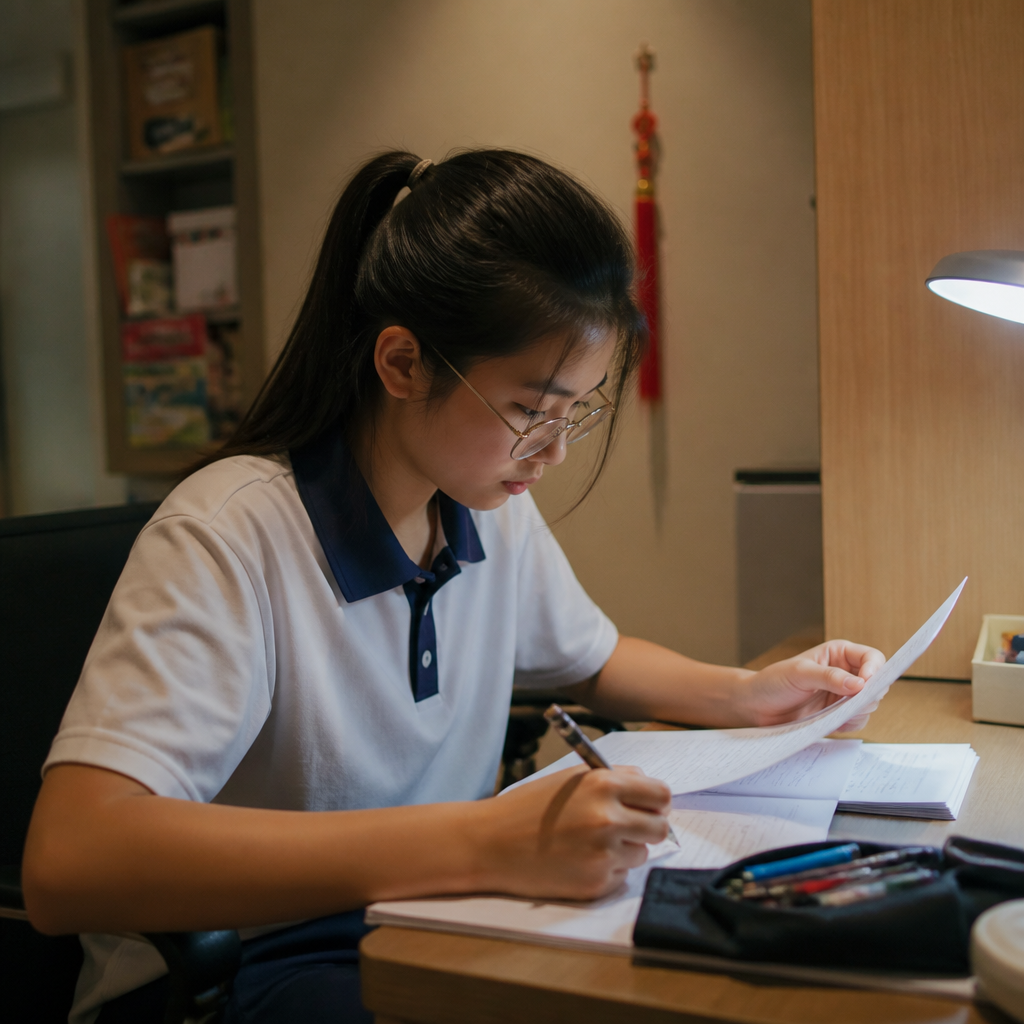
Model response:
Subject: Proposal for a Weekly Reading Corner
Dear Principal,
I am writing to propose setting up a weekly reading corner for students during recess and after school.
Students would benefit from this in several ways. First, it would encourage more students to read regularly, especially those who may not usually visit the library. Second, it would provide a calm space for students to relax and recharge during busy school days.
The reading corner could be set up in a sheltered area near the library. A small collection of books and magazines could be placed on movable shelves, with Student Council members helping to keep the area tidy and organised.
One possible challenge is that some books may be misplaced or damaged. To address this, we could introduce a simple sign-out system and place clear reminders for students to handle the materials responsibly.
Thank you for considering this proposal. I hope the school can implement this idea to promote a stronger reading culture.
Yours faithfully,
Daniel Tan
Secondary 2 Student Councillor
Why this works
- The tone is formal and respectful.
- Each bullet point is answered directly.
- The structure is logical and easy to follow.
- The ideas are practical.
These are the kinds of examples of situational writing for secondary school students that help students see the difference between writing something relevant and writing exactly what the task requires.
At this level, students also need to avoid sounding repetitive. If every paragraph begins with “First”, “Second”, and “Third”, the writing may feel mechanical. Variety in sentence structure and linking words can make the response more fluent while still staying concise.
5. A Simple Method for Answering Situational Writing Questions
If your child understands the definition but still asks how to answer situational writing questions in Singapore exams, a step-by-step method helps.
Use a clear exam structure
Why tone and format matter
One common problem is tonal confusion. A child writes to the principal as if texting a friend. Another problem is over-formality in a friendly letter, making it sound stiff and unnatural.
At home, this often shows up during tired evening revision. It is late, everyone is a bit drained, and the answer looks decent at first glance. Then you spot “Hey Principal” at the top. That one line tells you something important. The child may know English words, but still needs help matching language to situation.
For students who need guided practice with feedback on tone, format, and task fulfilment, working with our tutors can make revision more focused and much less stressful.
A useful exam habit is to leave one minute at the end to check three things: Did I answer every bullet point? Does my tone fit the reader? Did I use the correct sign-off or ending? This quick review can save marks that are otherwise lost to avoidable slips.
6. Common Mistakes and Practical Ways to Improve

Strong improvement usually comes from fixing a few repeated errors. Here are practical tips to improve situational writing for English exams in Singapore.
Common mistakes students make
Practical ways to improve
- Practise one format at a time. Spend one week just on emails before moving on to speeches or reports.
- Use colour-coded annotation. Highlight audience, purpose, and content points so the task becomes easier to manage.
- Do short timed drills. Planning drills are useful because they strengthen question analysis.
- Review model answers actively. Ask where each bullet point is answered and why the tone works.
- Build a small bank of opening and closing lines. This helps students start faster in exams without sounding memorised.
7. What Examiners Actually Look For
Understanding what examiners look for helps students write with more control and less guesswork.
For PSLE, the situational writing format for PSLE English paper Singapore should be secure enough that the child does not waste time second-guessing the basics during the exam.
A secondary student proposing a school initiative should sound practical and thoughtful. Clear writing usually scores better than vague enthusiasm.
It also helps to remember that examiners are not looking for dramatic flair in every line. They want evidence that the student understood the task and responded effectively. Relevance, control, and appropriateness usually matter more than trying to impress with difficult vocabulary.
8. Frequently Asked Questions
Is situational writing the same as composition?
No. Composition is usually creative or narrative writing. Situational writing is functional writing based on a given task, audience, and purpose. The student must respond directly to the situation instead of inventing a free-flowing story.
What formats should students know for situational writing in Singapore?
Students should be comfortable with emails, letters, reports, speeches, and proposals where relevant to their level. Not every level tests all formats equally, but students should understand how each format affects tone, structure, and language choices.
How long should a situational writing response be?
It depends on the exam requirements, but students should focus less on length and more on covering all content points clearly. A shorter answer that fully addresses the task is usually better than a long answer with missing details or irrelevant content.
What is the fastest way to improve marks?
The fastest improvement often comes from better question analysis. Many students already have enough language ability, but they lose marks by missing bullet points, choosing the wrong tone, or using the wrong format. Fixing these habits can lead to quick gains.
Should parents correct every grammar mistake?
Not always. If a parent corrects every line, the child may feel overwhelmed. It is often better to focus first on task fulfilment, format, and tone. Once those are more secure, grammar correction becomes more useful and less discouraging.
9. Conclusion
So, what is situational writing? It is purposeful, practical writing that asks students to respond to a specific context, reader, and task. In Singapore exams, success depends on reading the question carefully, identifying format and audience, covering every bullet point, and using the right tone. For primary school students, that often means mastering the basics clearly and accurately. For secondary students, it means adding stronger organisation and more mature language choices.
If your child has been losing marks because they are unsure what the examiner wants, this is a skill that can improve with the right guidance and practice. A few focused changes can make situational writing feel much less confusing. If you would like more personalised support, you can learn more about our tutors and find help that matches your child’s level and exam needs.


