


When both parents are working, PSLE preparation can feel less like a study plan and more like a daily juggling act. One parent is still in the office at 7pm, the other is replying to messages during dinner, and your child is waiting for help with a Science open-ended question that cannot be solved with a quick glance. In many Singapore households, this is not a rare bad day. It is simply the normal rhythm of the year.
The challenge is not just getting your child
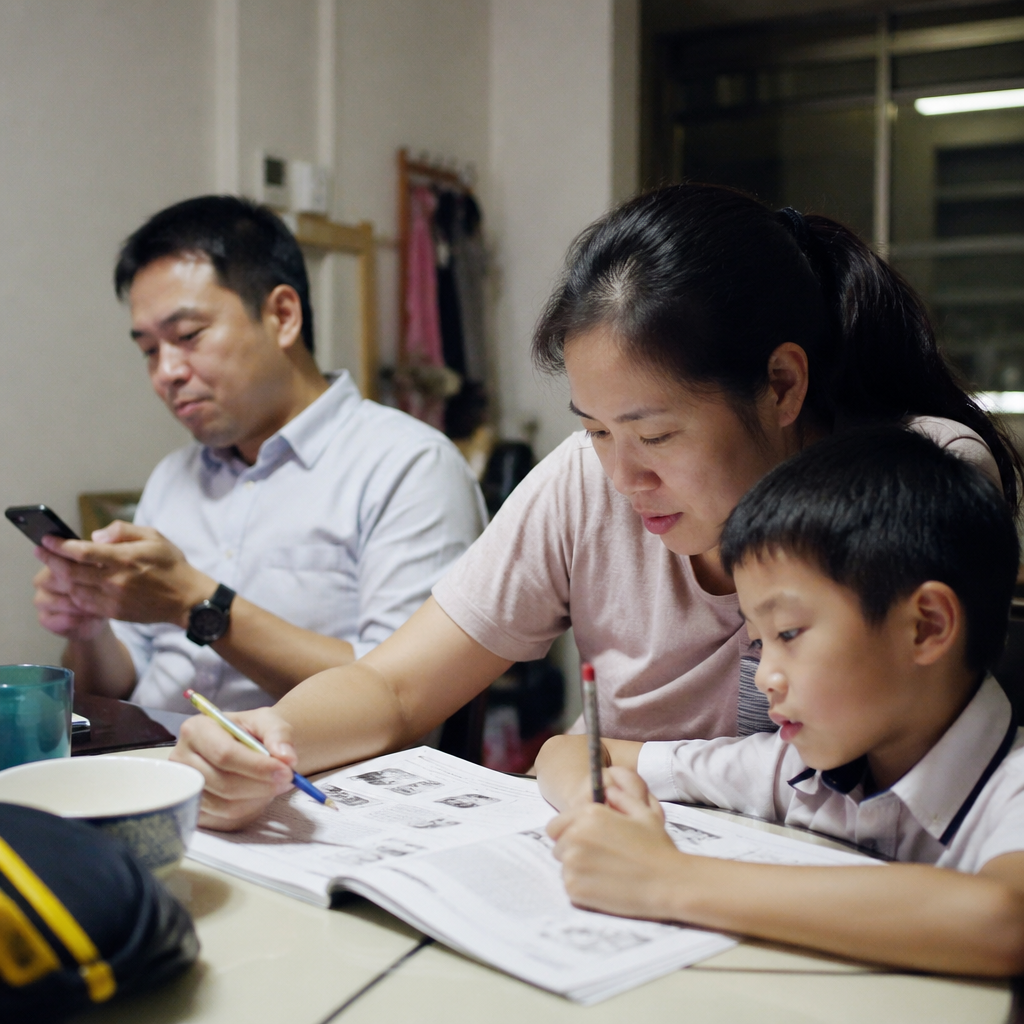
to study more. It is building a realistic system for PSLE preparation that fits around work deadlines, commuting time, enrichment schedules, and your child’s energy levels. For dual-income families, the goal is not perfection. It is consistency, calm, and enough structure so your child does not feel unsupported just because both parents are busy.
This guide focuses specifically on how working parents can manage PSLE year without burning themselves out or overwhelming their child. If you are trying to create a workable routine, decide where tuition fits in, and support your child even when time is tight, the strategies below are meant for exactly that.
Key Takeaways
- Build a weekly system, not a daily ideal. A realistic PSLE study schedule for working parents should account for late meetings, traffic jams, and tiring evenings. If Tuesday falls apart, the plan should still hold for the rest of the week instead of collapsing after one disrupted night.
- Keep the home routine simple and repeatable. A strong home study routine for primary school students works best when your child knows what happens after school, after dinner, and before bed without needing daily negotiation or repeated reminders.
- Focus parent time where it matters most. In dual-income households, you may only have 20 to 30 focused minutes on some nights. Use that time for checking mistakes, motivation, and planning instead of hovering over every worksheet from start to finish.
- Use tuition strategically, not emotionally. Tuition can reduce pressure at home when it fills a clear gap, such as weak subject foundations, lack of supervision after school, or the need for exam-focused practice in one or two subjects.
- Protect your child’s emotional stamina. Good parent support strategies for PSLE preparation include reassurance, clear expectations, and calm routines, especially when school papers, weighted assessments, and prelim results start to feel heavier.
Why PSLE Preparation Feels Harder in a Dual-Income Household
Families with two working parents are not less committed to their child’s education. The difficulty is that time and attention are split into small, tired fragments. By the time everyone gets home, dinner is late, bags are still unpacked, and your child may already be mentally done for the day.
The Real Issue Is Not Care, It Is Timing
A parent may genuinely want to supervise revision but still be stuck on the MRT replying to work messages at 6.45pm. Another may be home physically but mentally drained after back-to-back meetings. In this situation, balancing work and child exam preparation becomes difficult because the support that matters most, attention, consistency, and follow-up, is hardest to give when everyone is exhausted.
That is why many dual-income parents carry guilt through PSLE year. You may know your child needs more structure, but you are also trying to stay afloat at work. The answer is not to become a full-time tutor after office hours. The answer is to build a support system that does not depend on one parent being endlessly available.
PSLE Year Magnifies Weak Routines
If Primary 5 routines were already loose, PSLE year tends to expose that very quickly. A child who only studies when reminded may suddenly need regular revision in English, Math, Science, and Mother Tongue. A parent who used to check homework casually may now need to track corrections, topical weaknesses, and school paper dates.
For this reason, time management for PSLE students in Singapore is not just the child’s issue. It is a family logistics issue. The more predictable your household systems are, the less emotional strain there is on weeknights, and the fewer arguments you end up having when everyone is already tired.
Building a PSLE Preparation System That Works for Working Parents
A workable system starts with accepting one simple truth. Your family cannot run on a perfect timetable every day. It needs a flexible structure that still works when one parent is late or your child comes home tired after supplementary lessons.
Create a Weekly Anchor Plan
Instead of planning each day in isolation, map out the whole week on Sunday evening. Include school hours, CCA if any, tuition, meal times, and sleep. Then identify three to five anchor study blocks for the week.
For example, your child may do Math revision on Monday and Thursday from 7.30pm to 8.30pm, English comprehension on Wednesday after dinner, and a longer Science review on Saturday morning. If Tuesday gets disrupted by a late client call, the week still has enough structure to hold.
This is what a realistic PSLE study

schedule for working parents looks like. It is not packed every night. It is built around the family’s actual availability, which makes it far easier to sustain over many months.
Separate Independent Work From Parent-Guided Work
Not every task needs a parent sitting beside the child. Independent work can include vocabulary review, mental sums, corrections from marked worksheets, or reading model compositions. Parent-guided work should be reserved for tasks where your child tends to get stuck, such as Science explanation questions or reviewing careless mistakes in Math.
For instance, if you only reach home by 8pm, ask your child to complete one school worksheet independently before dinner. Later, you spend 20 minutes checking only the error patterns. That is far more sustainable than trying to supervise the entire session from start to finish, especially on weekdays.
Use Visible Tracking
A whiteboard, printed checklist, or shared family calendar helps children see what must be done without repeated verbal reminders. This reduces nightly friction. Instead of asking, “Have you studied?” for the third time, you can point to the plan and ask, “Which block are you on?”
Visible tracking also helps both parents stay aligned. If one parent is home late, the other can still see what has been completed and what needs follow-up. It also gives your child a clearer sense of progress, which matters a lot in a long year like PSLE.
Creating a Home Study Routine for Primary School Students When Parents Get Home Late
A good home study routine for primary school students should lower resistance, not create more battles. If your child needs a long negotiation every evening before opening a book, the routine is probably too complicated.
Keep the After-School Sequence Fixed
Children cope better when the evening follows a predictable order. A simple sequence could be snack, shower, short rest, independent revision block, dinner, then parent check-in. This matters because tired children often waste energy switching mentally between activities.
Take a familiar scenario. Your child reaches home at 3pm and you only return at 7.30pm. If there is no routine, the four hours may disappear into snacks, television, and half-finished homework. But if your child knows that 4pm to 4.45pm is always independent revision, you are not rebuilding momentum from zero every night.
Prepare Materials in Advance
Busy parents often lose time not in teaching, but in searching. The Math file is missing, the Science corrections are in another bag, and nobody can find the assessment book. On Sunday, spend 15 minutes organising the week’s materials into subject folders or trays.
This small step is especially useful for balancing work and child exam preparation because it cuts down the number of decisions needed on weekday nights. When you are tired, even small obstacles can turn into unnecessary stress.
Build In Short Recovery Time
PSLE students still need breathing room. A child who has been in school all day cannot jump straight into two hours of intense revision and stay productive. A 20-minute snack break or quiet rest period can prevent a full evening meltdown.
Parents sometimes worry that breaks waste time. In reality, strategic breaks improve time management for PSLE students in Singapore because a more settled child works faster, absorbs more, and is less likely to end up in tears over a worksheet that would normally be manageable.
How Tuition Can Support PSLE Preparation Without Overloading Your Child
For dual-income families who can afford extra support, tuition often helps not because parents are uninvolved, but because they are stretched. The right tutor can provide academic guidance, structure, and accountability during the hours when parents are unavailable.
Use Tuition to Solve a Specific Problem
Do not enrol in tuition just because everyone else is doing it. Match it to the actual bottleneck in your household. If your child struggles with problem sums and neither parent has the bandwidth to review methods carefully on weekday nights, Math tuition may remove a major source of stress. If English composition is weak and feedback at home is inconsistent, targeted English support may be more useful than adding another general worksheet.
This makes PSLE preparation more efficient because tuition fills a clearly defined gap instead of becoming another rushed activity on an already overloaded schedule.
Avoid Stacking Too Many Lessons
A common mistake is overcompensating for limited parent time by adding tuition across several subjects at once. The result can be a child who is always moving from school to tuition to homework, with no real time to absorb mistakes.
If your child has tuition on Monday, Wednesday, and Saturday, ask whether there is enough time left for corrections and review. A tutor is most helpful when there is space to act on feedback. Otherwise, your child may attend many lessons without improving much, and the whole family may just feel more rushed.
Choose Support That Fits Your Family Rhythm
Some families need a tutor who can come after school before parents return. Others need weekend support when both parents are available to follow through. The best arrangement is the one your household can sustain calmly for months, not just for two enthusiastic weeks.
If you are exploring options, you can contact us to discuss what kind of tutor arrangement fits your child’s schedule.
Parent Support Strategies for PSLE Preparation When Time Is Limited
Many parents assume support means sitting beside the child for long hours. In reality, some of the most effective parent support strategies for PSLE preparation take only a short time but make the child feel guided, seen, and secure.
Do a 15-Minute Nightly Review
Even on busy days, aim for a short check-in. Ask three specific questions: What did you revise today? What was difficult? What is the plan for tomorrow? This keeps you informed without turning every evening into an interrogation.
For example, if your child says Science was difficult because of keywords, you immediately know what to prioritise over the weekend. That is far more useful than a vague “study harder” conversation that leaves everyone frustrated.
Focus on Mistakes, Not Volume
A child can complete many pages and still repeat the same errors. When your time is limited, review error patterns. Is your child losing marks in Math because of careless copying, weak fractions concepts, or poor time allocation? Is English comprehension suffering because answers are too short or not lifted accurately?
This targeted approach improves PSLE preparation because it directs scarce parent attention to the highest-value areas instead of rewarding sheer volume of work. It also helps your child feel that studying has a purpose, rather than just becoming a pile of endless worksheets.
Keep Your Tone Calm During Setbacks
There will be rough moments. A poor weighted assessment result, unfinished homework, tears over a difficult paper. In those moments, your child does not just need correction. They need emotional steadiness.
A calm response might sound like, “This paper shows us what to work on next. We will break it down this weekend.” That gives direction without panic. For many children, this emotional safety is exactly what helps them recover and keep trying.
Share Responsibilities Between Parents
In dual-income households, one parent does not need to carry the entire PSLE load. Even if one parent is more academically involved, the other can still support the system. One can handle scheduling, file organisation, and communication with tutors, while the other reviews corrections or does nightly check-ins.
This division reduces resentment and makes the routine more stable. It also helps your child see that both parents are involved, even if in different ways. When responsibilities are shared clearly, fewer tasks fall through the cracks during busy weeks.
Time Management for PSLE Students in Singapore: Practical Routines for Busy Families
Strong time management for PSLE students in Singapore is not about squeezing every minute dry. It is about protecting the right hours and using them well.
Use Weekends for Deep Work
Weeknights are often best for shorter revision and school follow-up. Save heavier tasks for weekends, such as full paper practice, composition planning, or reviewing a week’s worth of mistakes. This suits dual-income families because parents are more likely to be mentally available on Saturday morning than on a rushed Wednesday night.
A practical example is doing one timed Math paper on Saturday, then reviewing corrections after lunch. On Sunday, your child revises Science concepts and prepares for the school week ahead. This rhythm usually feels much more manageable than trying to force long, demanding sessions into exhausted weekday evenings.
Plan Around Fatigue, Not Just Free Time
A child may technically have two free hours after dinner, but if they are sleepy and frustrated, that is not quality study time. Likewise, a parent may only have 30 minutes before bedtime but be fully focused. Put harder tasks into higher-energy windows.
This is why a successful PSLE study schedule for working parents often includes lighter weekday tasks and more demanding weekend blocks. It respects how people actually function, which is usually the difference between a plan that survives and one that gets abandoned.
Review the Plan Every Two Weeks
PSLE year changes quickly. School may assign more revision, prelims may expose new weak areas, or your work schedule may suddenly become busier. Revisit the routine every two weeks and ask what is working, what is causing friction, and what needs to change.
A short review can cover simple questions. Is your child consistently too tired on one tuition day? Are corrections piling up? Is one subject getting neglected because everyone assumes it is “fine”? Small adjustments made early are much easier than trying to fix a chaotic routine near prelim season.
For official information on the PSLE and broader education matters, parents can refer to the Ministry of Education Singapore.
Frequently Asked Questions
How many hours of PSLE preparation does a child in a dual-income household need?
There is no single number that fits every child. What matters more is consistency and quality. A child with strong school support and targeted tuition may do well with focused weekday revision plus longer weekend sessions. A child with weaker foundations may need more structured support. The key is to avoid random bursts of studying only when exams are near.
What if both parents come home too late to supervise every night?
Then the system must rely on independent tasks, clear routines, and outside support where needed. This is exactly why many families use tuition during PSLE year. It helps bridge the supervision gap without requiring parents to become full-time coaches after work.
Should we start tuition for all subjects during PSLE year?
Usually no. Start with the subjects causing the most stress or showing the clearest weakness. If your child is coping in English and Mother Tongue but consistently struggling in Math, solve that first. Too many tuition lessons can crowd out rest and revision.
How can we reduce arguments at home over studying?
Use a visible schedule, keep instructions predictable, and avoid discussing every subject every night. Children argue less when expectations are clear. It also helps when parent check-ins are short and specific rather than emotionally charged after a long workday.
What should we do if our child resists independent study?
Start small. Give one clearly defined task, a fixed time block, and a visible endpoint. Many children resist because the instruction feels too broad, not because they refuse all studying. A 25-minute task with a checklist is often easier to accept than “Go revise your Science.”
Is it normal for working parents to feel guilty during PSLE year?
Yes, very normal. Many parents feel they are not doing enough because they cannot be physically present all the time. But children do not only need hours. They need structure, encouragement, and the right support. A calm, sustainable plan often helps more than exhausted over-involvement.
Conclusion
Managing PSLE preparation in a dual-income household is not about copying another family’s routine or trying to supervise every worksheet personally. It is about building a system that matches your real life, your work demands, and your child’s learning needs. A practical home study routine for primary school students, a realistic PSLE study schedule for working parents, and thoughtful parent support strategies for PSLE preparation can make PSLE year feel far more manageable. When needed, tuition can also ease the pressure by giving your child consistent academic guidance while helping you with balancing work and child exam preparation.
The most effective plans are usually the

simplest ones: a predictable weekly structure, clear independent tasks, short but focused parent check-ins, and enough flexibility to absorb the occasional bad day. When your child knows what to expect and feels supported rather than chased, revision becomes much easier to sustain.
We hope this article has given you a clearer picture of managing PSLE preparation in a dual-income household. If you’re looking for structured academic support that fits your family’s schedule, our tutors at MindFlex are experienced, carefully matched to each student, and ready to help. Contact us for a free consultation and let us find the right tutor for your child.


