


If both parents are working, PSLE preparation can feel less like a study plan and more like a daily logistics puzzle. One parent is rushing from the MRT to a late meeting, the other is replying to messages while thinking about dinner, and your child still has revision to complete before bedtime. In many Singapore households, the challenge is not whether parents care enough. It is whether there are enough hours in the day to support a child consistently.
The good news is that effective PSLE preparation does not require parents to sit beside their child for three hours every night. What it does require is structure, realistic expectations, and the right support system. For dual-income families who can afford tuition, the goal is to reduce stress, protect family routines, and make sure your child gets steady academic guidance even when your workdays are unpredictable.
This guide focuses specifically on managing PSLE preparation in a dual-income household, with practical ways to build routines, use tuition wisely, and support your child without burning out.
Key Takeaways
- A successful PSLE preparation plan for dual-income families should be simple, repeatable, and realistic for weekday evenings. This matters because routines that depend on perfect timing usually fall apart once work runs late or a child comes home tired from school.
- A strong PSLE study schedule for working parents depends on fixed routines, not last-minute decisions made at 9pm. When your child already knows what happens on each day, there is less resistance, less confusion, and less emotional friction at home.
- Good time management for PSLE students in Singapore means balancing school, rest, revision, and tuition without overloading the child. A packed schedule may look productive, but too much work often leads to fatigue, careless mistakes, and lower motivation.
- Balancing work and child exam preparation becomes easier when parents split roles clearly, even if one handles academics and the other manages logistics. Shared responsibility reduces mental load and helps the household stay organised during a demanding school year.
- A consistent home study routine for primary school students can work even when parents come home late, if expectations are clear. Children cope better when they know the order of tasks, where materials are kept, and what to do before a parent checks in.
- Practical parent support strategies for PSLE preparation include weekly check-ins, tutor coordination, and protecting the child’s emotional well-being. Academic progress matters, but so does keeping the home environment calm enough for your child to stay steady through the year.
- Monday and Wednesday, 7.30pm to 8.30pm for Math and Science revision
- Saturday morning, 10am to 12pm for a longer review session
- Sunday evening, 20 minutes for planning the week ahead
- 30 to 45 minutes of focused revision
- 15 minutes of corrections or review
- 10 minutes packing the school bag and preparing for the next day
- School homework
- Tuition days
- Revision subjects
- Rest slots
- Test dates
- Reviewing weak topics
- Correcting misconceptions quickly
- Teaching answering techniques
- Keeping the child on a revision schedule
- Weekday evenings for short targeted tasks
- Saturday mornings for full papers or intensive revision
- Sunday afternoons for corrections and planning
- Parent A handles tutor communication and academic tracking
- Parent B handles logistics, printing papers, and weekend scheduling
- What did you revise today?
- What was difficult?
- What needs help tomorrow?
- Did you correct your mistakes?
1. Why PSLE Preparation Feels Harder in a Dual-Income Household
Dual-income parents often face a very specific kind of stress during PSLE year. It is not just about academics. It is about timing, energy, and mental load. You may genuinely want to review Science open-ended answers with your child, but by the time everyone is home, showered, and fed, it is already 9pm. Your child is tired. You are tired. Even a simple correction can suddenly turn into an argument.
1.1 The real problem is consistency, not concern
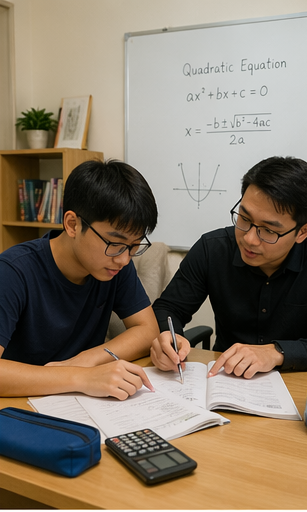
Most working parents are not struggling because they are uninvolved. They are struggling because consistency is hard to maintain when work hours shift. One week, you can supervise revision every evening. The next week, a project deadline changes everything. This is why PSLE preparation in a dual-income home must be built around systems, not good intentions.
For example, if your child only studies properly when you are physically present, revision will collapse the moment one parent has to work late. But if there is a fixed routine, such as 7.30pm to 8.30pm for topical revision, followed by 15 minutes of corrections, the child knows what happens even before you walk through the door.
1.2 Children also feel the household pressure
PSLE students are sensitive to stress at home. They can tell when parents are stretched. A child may not say, “Mummy, I know you are overwhelmed,” but you may see it in other ways. They procrastinate more. They become tearful over a small mistake. They ask repeatedly if they are doing enough.
That is why balancing work and child exam preparation is not only about squeezing in more practice papers. It is also about creating a calmer environment. In many homes, what helps most is not another assessment book. It is a child knowing, “Even if my parents are busy, there is a plan, and I am not handling this alone.”
2. Building a PSLE Study Schedule for Working Parents

The best PSLE study schedule for working parents is one that survives real life. It should work on normal days, busy days, and slightly chaotic days. If your plan only works when everyone is home by 6.30pm, it is probably too fragile.
2.1 Start with fixed anchors in the week
Instead of planning every hour, identify fixed anchors. These are non-negotiable study blocks that stay in place each week. For example:
These anchors make PSLE preparation less reactive. Instead of asking daily, “Do you have homework? What should you revise tonight?” your child already knows the flow.
2.2 Keep weekday expectations tight and realistic
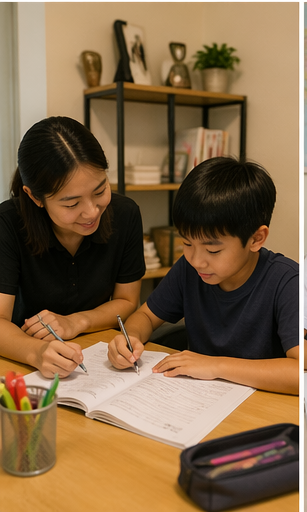
A common mistake in time management for PSLE students in Singapore is overloading weekday evenings. After school, CCA, homework, dinner, and shower, many Primary 6 students simply do not have the mental stamina for three extra hours of revision.
A better weekday routine may look like this:
This is enough to maintain momentum without causing nightly meltdowns. If your child has tuition that day, the home session can be even lighter. The point is consistency, not exhaustion.
3. Creating a Home Study Routine for Primary School Students When Parents Come Home Late
A good home study routine for primary school students should not depend entirely on live supervision. In a dual-income household, that is the difference between a plan that works and one that falls apart by week two.
3.1 Set up a routine your child can follow independently
Children do better when the sequence is predictable. For example, after dinner your child might follow this order:
1. Take out the revision file
2. Complete one assigned task
3. Mark or check against model answers if appropriate
4. Flag questions they do not understand
5. Put completed work into a tray for parent or tutor review
This sounds simple, but it reduces friction. Without a system, a child may spend 20 minutes sharpening pencils, looking for worksheets, and asking what to do next. With a system, the study session starts faster and feels less overwhelming.
A practical example: if you know you will only be home at 8.45pm, leave a written instruction before leaving for work: “Complete Booklet A, pages 12 to 15. Circle Q3 and Q6 if unsure. I will check after your shower.” This gives your child structure without needing you there physically.
3.2 Use visual planning tools
For busy households, visual tools help a lot. A weekly whiteboard or printed timetable can show:
This is especially useful for PSLE preparation because children can see that not every day is equally heavy. On Tuesday, there may be only English corrections. On Thursday, there may be a full Science review. When the week is visible, the workload feels more manageable and less like a constant cloud hanging over the home.
4. Using Tuition Strategically in PSLE Preparation
For families with the budget for tuition, the goal should not be to fill every free slot. It should be to create support where parental time is thinnest. In a dual-income household, tuition works best when it solves a specific problem.
4.1 Identify where your family needs help most
Different families need different forms of support. Some need academic teaching because parents are not confident in upper primary Math methods or Science answering techniques. Others need accountability because the child only works properly when another adult is guiding them.
For example, if both parents regularly get home after 8pm, a tutor can help maintain momentum on high-value tasks like:
This is often much more effective than parents trying to cram all support into weekends, when everyone is already tired and the pressure has built up.
4.2 Coordinate the tutor with your home routine
Tuition should fit into the household rhythm, not create more chaos. If your child already has school commitments on Tuesday and Thursday, adding tuition on both nights may leave them drained. A better arrangement may be one weekday session plus one weekend session, with lighter home follow-up in between.
This is where parent support strategies for PSLE preparation matter. Parents should communicate with the tutor clearly. Share school test results, weak topics, and what is realistic at home. If your child can only manage 20 minutes of follow-up on weekdays, say so. A good tutor will adjust expectations and focus on what moves the needle most.
If you are looking for support, you can contact us to discuss a suitable arrangement. You may also wish to learn more about our tutor matching process.
5. Time Management for PSLE Students in Singapore, Without Turning the Home Into a Pressure Cooker
Good time management for PSLE students in Singapore is not about packing every hour with work. It is about helping your child use energy wisely. In PSLE year, some students look busy all the time but are not actually learning well. They are just tired.
5.1 Separate high-focus tasks from low-energy tasks
Not all revision needs the same level of concentration. High-focus tasks include problem sums, comprehension, and Science open-ended practice. Low-energy tasks include filing worksheets, reviewing vocabulary, or re-reading corrections.
This matters for dual-income families because timing is everything. If your child is mentally fresh on Saturday morning, that is the time for demanding work. If it is 9pm on a Wednesday, use that slot for lighter review.
A practical weekly pattern could be:
This makes PSLE preparation more sustainable. It also reduces those painful late-night scenes where a child is staring blankly at a Math question while a parent is trying hard to stay patient.
5.2 Protect sleep and decompression time
Parents sometimes feel guilty if every evening is not academically productive. But a child who is constantly sleep-deprived will not absorb revision well. In fact, one of the most effective ways of balancing work and child exam preparation is to stop assuming that more hours automatically means better outcomes.
If your child has had a long school day, one tuition session, and a spelling test the next morning, it may be wiser to shorten revision and prioritise rest. A calm, rested child often performs better than an exhausted one who completed two extra worksheets.
6. Parent Support Strategies for PSLE Preparation When Time Is Limited
When parents are busy, support has to be intentional. You may not have long weekday hours, but even short, focused involvement can still make a real difference.
6.1 Divide responsibilities between parents
In many dual-income homes, one parent ends up carrying the full PSLE mental load. They remember test dates, chase corrections, message tutors, and monitor progress. Over time, this becomes exhausting.
A better approach is to split roles clearly. For example:
This sounds small, but it reduces resentment and confusion. If your child has a Science topical test coming up, both parents know who is checking what, and the work does not silently fall onto one person.
6.2 Use short but meaningful check-ins
You do not need a one-hour debrief every night. Even a 10-minute check-in can be powerful if it is focused. Ask:
These questions build accountability. They also help your child feel seen. For a Primary 6 student, that matters. Sometimes what they need most is not another lecture on PSLE. It is hearing, “I know today was tiring. Let’s just identify the two things to fix tomorrow.”
6.3 Watch for emotional overload
PSLE stress does not always look dramatic. Sometimes it shows up as stomach aches before school, unusual irritability, or a child who suddenly says they hate a subject they used to enjoy. These are signs to pause and adjust the plan.
Strong parent support strategies for PSLE preparation include knowing when to push and when to lighten the load. If your child is spiralling after repeated mistakes, that may be the moment for a tutor to step in with calm guidance, rather than turning the evening into another conflict.
7. Frequently Asked Questions
7.1 How many hours a day should a Primary 6 child spend on PSLE preparation?
There is no fixed number that suits every child. For dual-income households, quality matters more than sheer volume. On weekdays, 45 to 90 minutes of focused work is often more realistic than long sessions. On weekends, children can usually handle longer revision blocks. The key is whether your child is learning consistently, not whether every evening looks intense.
7.2 What is a realistic PSLE study schedule for working parents?
A realistic PSLE study schedule for working parents usually includes short weekday revision blocks, one or two tuition sessions, and longer weekend review sessions. For example, weekday evenings can be used for targeted practice and corrections, while Saturday is reserved for tougher subjects or full papers. The schedule should still work even if one parent gets home late.
7.3 Should both parents be equally involved in PSLE preparation?
Not necessarily in the same way, but both should contribute. One parent may be stronger in academic supervision, while the other may be better at managing logistics and emotional support. In a dual-income household, equal involvement does not mean identical roles. It means shared responsibility.
7.4 When should working parents consider getting a tutor?
Consider tuition when your child needs subject-specific help, struggles to stay consistent without supervision, or when home support is becoming stressful and unsustainable. For many dual-income families, tuition is useful not only because of content support, but because it creates structure and accountability.
7.5 Where can parents find reliable information about the PSLE?
For official updates on curriculum and examinations, refer to the Ministry of Education Singapore website. This is especially helpful if you want to confirm the latest information instead of relying on hearsay from parent chats.
8. Conclusion
Managing PSLE preparation in a dual-income household is not about trying to do everything yourself. It is about building a system that still works on busy days, giving your child structure without constant nagging, and using support wisely when family time is limited. A realistic routine, sensible time management for PSLE students in Singapore, and clear parent support strategies for PSLE preparation can make the year feel far less overwhelming.
We hope this article has given you a clearer picture of managing PSLE preparation in a dual-income household. If you’re looking for structured academic support that fits your family’s schedule, our tutors at MindFlex are experienced, carefully matched to each student, and ready to help. Contact us for a free consultation and let us find the right tutor for your child.


