


If you are wondering how your child can do well for English Oral, you are not alone. Many students in Singapore can manage written English quite well, but freeze when they have to speak in front of an examiner. Parents see it too. It is the night before the oral exam, your child has revised vocabulary lists, but the moment you ask, “Tell me what you think about this picture,” they give a one-line answer and look down.
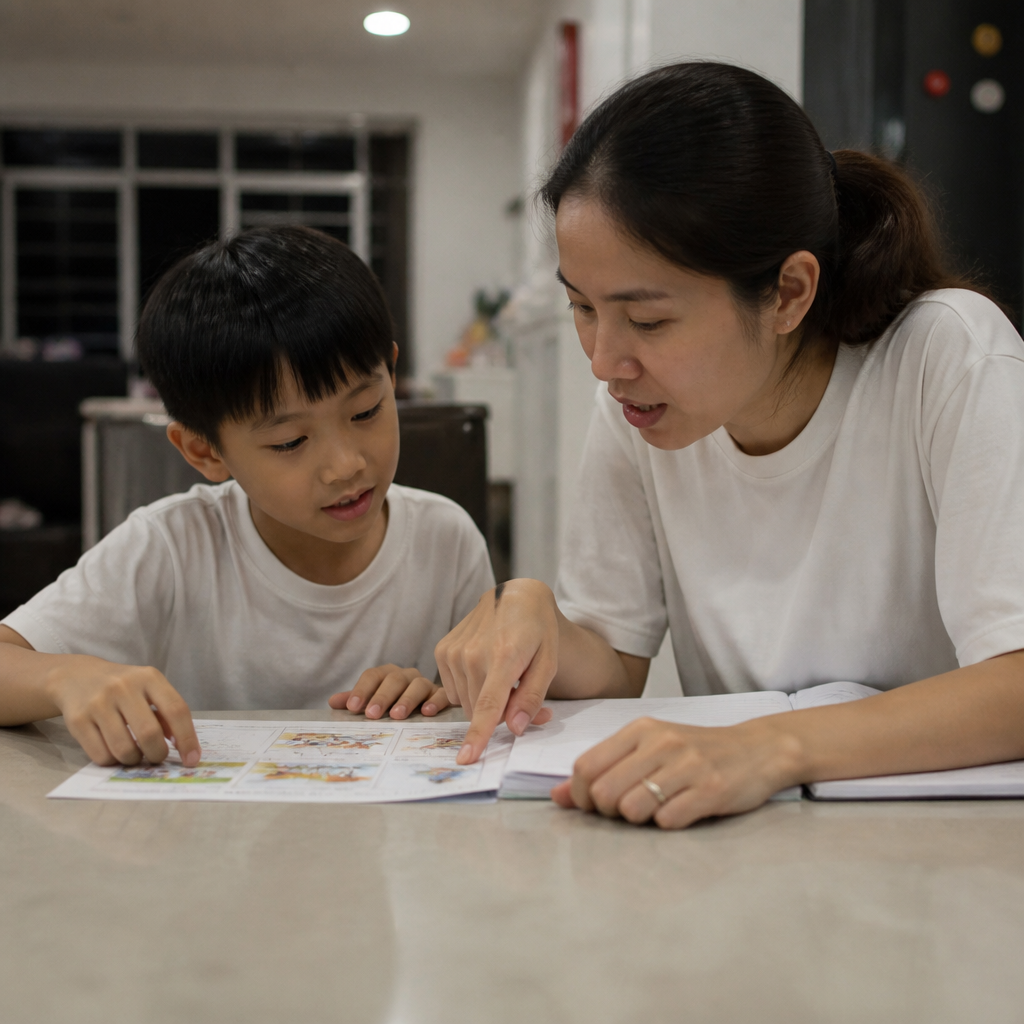
The good news is that oral can be prepared for step by step. Whether your child is facing PSLE English Oral, a school-based primary oral exam, or the Secondary English oral component, the skills tested are clear. Examiners are looking for clarity, fluency, pronunciation, relevant ideas, and a personal response. With the right structure, regular practice, and confidence-building strategies, students can improve steadily.
Key Takeaways
- Oral is not about sounding perfect. It is about speaking clearly, naturally, and relevantly under exam conditions.
- Students should focus on the main oral components: reading aloud, picture discussion, and stimulus-based conversation.
- Primary and Secondary oral exams share the same foundations, but Secondary students are usually expected to give fuller and more mature responses.
- Short answers are one of the biggest problems. A simple point should be followed by a reason, an example, or a personal link.
- Confidence grows through regular exposure. Short daily speaking sessions at home often work better than one long weekly session.
- Parents can support oral preparation by asking realistic questions about school, transport, food, technology, and community life in Singapore.
- Memorised answers are usually less effective than natural responses that fit the question properly.
1. What Examiners Look for if You Want to Know How to Do Well for English Oral
Before students can improve, they need to know what “doing well” actually means. In Singapore oral exams, strong performance usually comes down to a few key areas. These expectations are aligned with the English language syllabus from MOE and the exam format familiar to schools and national exams.
1.1 Clarity, fluency, and pronunciation
Clarity means the examiner can easily understand what the student is saying. This does not mean using complicated words. A Primary 6 student who says, “I think the boy should apologise because he was careless and hurt his friend’s feelings,” is clearer than one who tries to use advanced vocabulary but stumbles halfway.
Fluency means speaking in a smooth, connected way. Many students speak in fragments when nervous. What helps is training them to turn short phrases into full thoughts, such as, “The people in the picture seem to be at a park, and they look like they are taking part in a community event.”
Pronunciation matters because even a good idea can be lost if key words are unclear. The goal is not an accent change. It is understandable speech.
1.2 Relevant ideas and personal response
A common reason students lose marks is that they stay too general. If asked about kindness, some say, “Kindness is important because it is good.” That is too thin. A better answer would be, “Kindness is important because small actions can affect someone’s whole day. For example, if a classmate drops her books and nobody helps, she may feel embarrassed. But if someone helps her pick them up, she feels supported.”
The personal response is especially important in conversation tasks. Examiners want to hear what the student thinks, feels, and would do. Students who link the topic to school, family, CCA, or daily life in Singapore usually sound more engaged and convincing.
2. How to Do Well for English Oral in Primary School
For primary students, especially those preparing for PSLE, oral success often depends on simple habits done consistently. Many children know more than they can express. The challenge is helping them say their ideas fully and calmly.
2.1 What Primary students are usually tested on
Primary oral tasks often require students to read aloud clearly and respond to visual or spoken prompts with relevant ideas. At this level, the examiner is not expecting a speech that sounds like an adult. They want age-appropriate answers that are understandable, organised, and sincere.
For example, if the topic is about helping others, a Primary student should be able to say, “I think helping elderly people is important because some of them may have difficulty carrying heavy bags. If I saw an elderly person at the market, I would offer to help.”
2.2 Best ways to prepare for English oral exams in Singapore for primary students
One of the best ways to prepare for English oral exams in Singapore at the primary level is to train children to stretch their answers. A useful formula is: point, reason, example, personal link.
If the child says, “Students should exercise,” the parent can prompt gently:
- Why?
- Can you give an example?
- Do you do this yourself?

The answer then becomes, “Students should exercise regularly because it keeps them healthy and helps them focus better in class. For example, if a student only stays indoors and uses a device all day, he may become tired and inactive. I like cycling with my family at East Coast Park, and I feel more energetic after that.”
This is also where English oral practice at home for primary students matters most. Ten minutes after dinner can be enough. Show a picture, ask one question, and help the child build a longer answer without scolding or rushing.
3. How to Do Well for English Oral in Secondary School
Secondary students face a similar oral structure, but the expected depth is usually higher. Their ideas should be more developed, and their responses should show maturity, awareness, and the ability to handle broader topics.
3.1 How Secondary oral responses should be different
A Secondary student can no longer rely on very basic statements like, “This is good because it helps people.” Older students need to explain impact, consequences, or different perspectives.
For instance, if asked whether technology improves communication, a stronger Secondary response could be, “Technology improves communication because people can stay connected instantly, even when they are busy or far apart. However, it can also reduce face-to-face interaction. For example, some families sit together at dinner but everyone is looking at a phone instead of talking.”
3.2 Similarities between Primary and Secondary oral exams
Even though Secondary oral expects more mature content, the foundations are the same. Students still need clear pronunciation, smooth delivery, relevant ideas, and a personal response. In both levels, very short answers are risky.
If the examiner asks, “Would you enjoy taking part in this activity?” a one-line answer like “Yes, because it looks fun” is too limited. A fuller answer such as “Yes, I would enjoy taking part because it allows me to work with others and learn something new. For example, if it were a community clean-up, I would feel proud to contribute to my neighbourhood instead of just complaining about litter” gives the examiner more to assess.
4. Tips for Picture Discussion in English Oral Singapore Students Can Use Immediately
Many students panic when they see the visual stimulus because they do not know where to start. The best tips for picture discussion in English Oral Singapore students can use are simple and repeatable.
4.1 Start with what you can clearly see
Do not force fancy ideas in the first sentence. Begin with a clear observation. For example, “The picture shows a group of students in a school canteen. One of them has spilled a drink, and another student is helping to clean it up.”
From there, move to what is happening, what the people may be feeling, and what the bigger message could be.
A useful approach is:
- Describe the main action.
- Mention feelings or reactions.
- Suggest the lesson or issue.
So instead of saying only, “They are in school,” the student says, “The picture shows a busy school canteen. A student seems embarrassed after spilling a drink, while his friend is helping him clean up. This suggests the importance of being helpful and staying calm in an unexpected situation.”
4.2 Build ideas beyond description
A major mistake is stopping at description. If the picture shows a family using devices at the dining table, the student can go further:
- What is the issue?
- Why does it matter?
- What should be done?
A stronger response might be, “Although the family is physically together, they do not seem to be interacting. This may affect family bonding because mealtimes are one of the few chances for meaningful conversation. I think families should set aside device-free time, especially during meals.”
5. How to Answer Stimulus-Based Conversation English Oral Questions
For many students, the hardest part is thinking on the spot when the examiner asks follow-up questions. If you want to know how to answer stimulus-based conversation English Oral questions well, the goal is not to sound clever. It is to sound thoughtful, relevant, and real.
5.1 Use a simple answer structure
A practical format is:
- Give your stand.
- Explain why.
- Give an example.
- Add a personal link if possible.
For example, if the question is, “Do you think students should do more community service?” a weak answer is, “Yes, because it is good.”
A stronger answer is, “Yes, I think students should do more community service because it helps them become more aware of other people’s needs. For example, if students spend time with elderly residents or help to distribute food, they learn empathy and responsibility. In school, I joined a Values in Action activity once, and it made me realise that even small efforts can make a difference.”
5.2 Handle difficult questions without freezing
Sometimes the student does not know much about the topic. That is normal. The key is to stay calm and answer using everyday experience.
If asked, “How can neighbourhoods become more caring?” the student does not need expert knowledge. They can say, “I think neighbourhoods become more caring when residents know one another instead of staying distant. For example, people can greet their neighbours, help elderly residents carry groceries, or organise simple events at the void deck. In my block, I have seen neighbours helping each other during heavy rain, and that creates a stronger sense of community.”
This approach works because it uses familiar Singapore settings and natural examples.
6. How to Improve English Oral Exam Confidence Singapore Students Often Struggle With
Confidence is not built by saying, “Don’t be nervous.” It grows when students feel prepared, know what to do, and have practised under realistic conditions.
6.1 Reduce fear through predictable practice
Fear becomes worse when oral practice is random. If a child only practises once in a while, every session feels like a test. But if oral becomes part of normal routine, it feels less threatening.
For example, a parent can set a 10-minute routine:
- 2 minutes reading aloud
- 3 minutes picture discussion
- 5 minutes conversation questions
This is manageable even on busy weekdays. A child who practises this way four times a week will feel much more ready than one who crams two days before the exam.
Students can also record themselves. After a few rounds, they start noticing where they speak too softly, too quickly, or unclearly.
6.2 Replace perfection with progress
Some students become silent because they are afraid of making grammar mistakes. But oral examiners are not expecting flawless speeches. They want communication. A student who speaks clearly with a few small mistakes often performs better than one who hesitates for too long trying to be perfect.
Parents should also be careful with tone during practice. If every attempt is met with, “Wrong, say it again,” the child may become even more anxious. A better way is, “That was a good idea. Now let’s make it longer,” or “Your point is clear, can you add an example?”
7. English Oral Practice at Home for Primary Students and Secondary Students
Home practice can make a huge difference when it is focused and realistic. The goal is not to turn home into another classroom. It is to create regular speaking opportunities that match exam tasks.
7.1 Simple home practice methods that actually work
For English oral practice at home for primary students, use familiar topics first. Ask about school recess, helping at home, playground safety, visiting grandparents, or recycling. A parent might show a photo of a hawker centre and ask, “What is happening here?” followed by, “Do you think children should help clear their trays?”
For Secondary students, move to broader themes such as social media, healthy living, public behaviour, or environmental responsibility. A question like, “Do you think young people spend too much time online?” invites opinion, explanation, and examples.
A helpful routine is to keep a jar of oral topics. Before dinner or before bed, the student picks one and speaks for a minute. Over time, this builds quick thinking and makes speaking feel less intimidating.
7.2 Common mistakes to correct during home practice
One common mistake is over-rehearsing model answers until the child sounds robotic. Another is allowing one-line answers to pass without follow-up. A third mistake is correcting every small grammar error immediately, which can break the student’s flow and confidence.
It is often better to let the child finish speaking first, then point out one or two areas to improve. For stronger exam readiness, students and parents can also review support materials from SEAB and seek structured help where needed.
8. Frequently Asked Questions
8.1 How often should students practise oral before exams?
Short and regular practice usually works best. Around 10 to 15 minutes, four to five times a week, is often more effective than a single long session.
8.2 What if my child has ideas but cannot express them well?
This is very common. Start by letting the child answer in simple sentences, then guide them to add one reason and one example.
8.3 Are memorised phrases helpful for oral exams?
Useful sentence starters can help, but full memorised answers are risky. A phrase like “In my opinion” or “One reason is that” is fine. But memorising entire responses often makes students sound unnatural.
8.4 How can students improve pronunciation for oral?
Reading aloud daily helps a lot, especially when students slow down and focus on clear word endings. They can also listen to good spoken English and repeat after it.
8.5 What should students do if they feel nervous during the exam?
Pause, breathe, and start with one clear sentence. Nervousness usually settles once the student begins speaking.
9. Conclusion
Learning how to do well for English Oral in Singapore is not about last-minute memorisation or trying to sound impressive. It is about building a few reliable habits, speaking clearly, developing ideas with examples, and practising often enough that the exam format feels familiar. For both Primary and Secondary students, the strongest oral responses are usually the ones that are relevant, sincere, and well supported. If your child tends to freeze, give short answers, or worry about pronunciation, these are all skills that can improve with the right guidance and regular practice at home.
If you would like extra support, you can also explore structured help through our English tuition page.
We hope this article has given you a clearer picture of how to do well for English Oral in Singapore. If you’re looking for specific help with PSLE oral preparation, Secondary English oral practice, or a tutor who can build your child’s speaking confidence step by step, our tutors are experienced, carefully matched to each student, and ready to help. Contact us for a free consultation and let us find the right tutor for your child.


