


If you are wondering how to do well for English oral, you are not alone. Many parents in Singapore have seen the same scene before an oral exam. Their child is staring at the passage, speaking too softly, stumbling over words, or giving one-line answers during conversation practice. Very often, students know more than they manage to say. But nerves, unclear pronunciation, and not knowing how to develop an idea can pull their marks down.
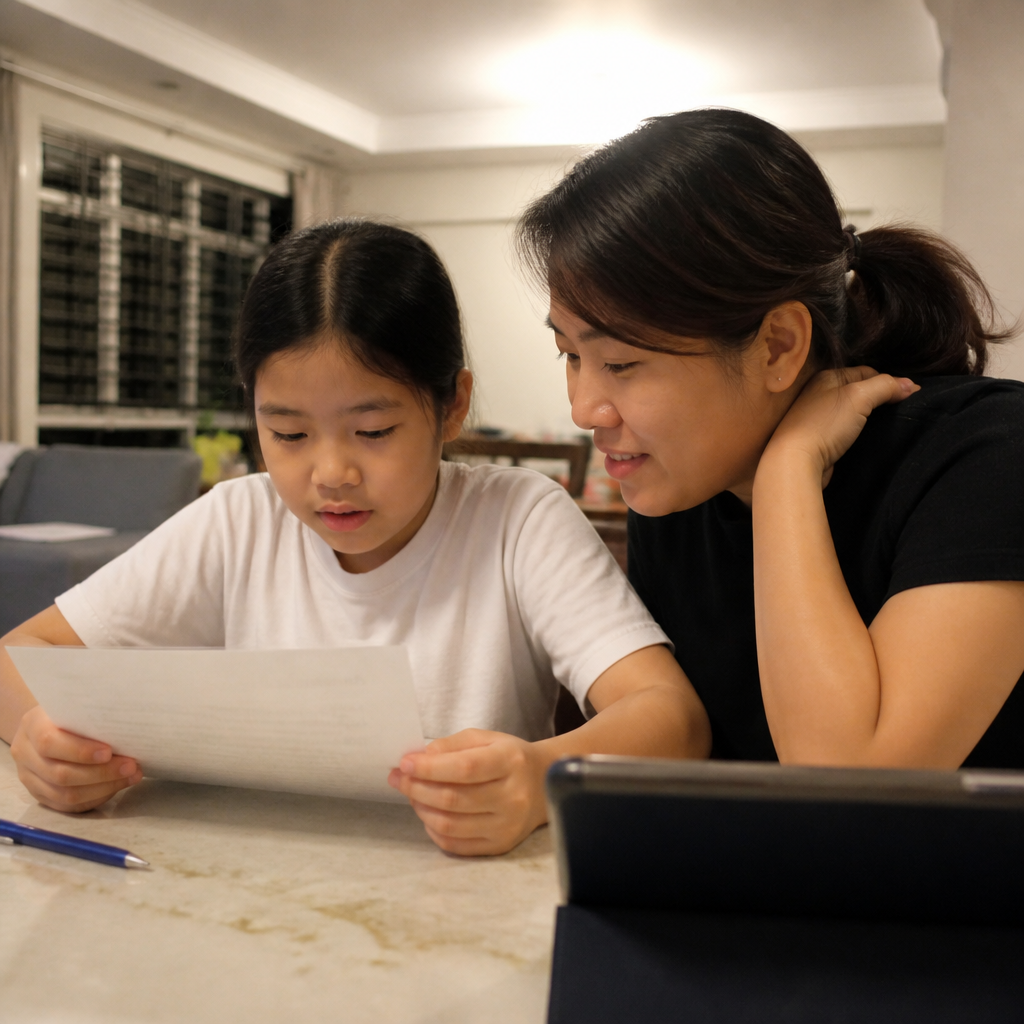
The good news is that English oral is a skill that can be built step by step. For both PSLE and secondary school students, strong oral performance usually comes from focused practice in two areas: reading aloud and stimulus-based conversation. When students understand what examiners are listening for, practise in realistic ways at home, and learn how to speak with calm confidence, improvement becomes much more achievable. This guide will show parents and students exactly how to prepare, what to practise, and how to speak more confidently for better results in Singapore English oral exams.
Key Takeaways
- To do well for English oral, students need to train both reading aloud and stimulus-based conversation together.
- Confidence improves with repetition in exam-like conditions.
- Reading aloud is not just about saying words correctly. It is also about expression, pacing, and meaning.
- Students score better in conversation when they answer, explain, and give examples.
- Primary and secondary students need slightly different preparation.
- Home practice works best when it is specific and realistic.
1. What Examiners Look For When Learning How to Do Well for English Oral
Before students can improve, it helps to know what a good performance actually sounds like. In Singapore, oral exams generally focus on two key components: reading aloud and stimulus-based conversation. According to the English Language syllabus and assessment approach used in schools, students are expected to communicate clearly, speak appropriately, and respond thoughtfully. Parents can refer to the Ministry of Education English Language syllabus and the Singapore Examinations and Assessment Board for official information.
1.1 Reading aloud is about clarity and meaning
Many students assume reading aloud is mainly about not mispronouncing words. That matters, but it is only one part of the picture. Examiners also listen for pace, expression, pauses, and whether the student understands the meaning of the passage.
For example, if the sentence says, “To her surprise, the whole class burst into laughter,” the student should not read it in a flat, robotic way. A small change in tone on “surprise” and “burst into laughter” helps the reading sound more natural and meaningful.
1.2 Stimulus-based conversation is about ideas and communication
For the conversation section, examiners are not looking for memorised model answers. They want to hear how well the student responds to the topic, explains personal views, and supports ideas with examples.
A weak response might be, “I think it is good.” A better one could be, “I think it is good because it encourages people to exercise together. For example, when schools organise sports events, students feel more motivated when their friends are involved.” This kind of answer shows thought, relevance, and the ability to speak in connected sentences.
2. How to Do Well for English Oral in Reading Aloud
One big part of how to do well for English oral is improving reading aloud. This is especially important for younger students, and many parents search for tips for primary school English oral reading aloud because this is where children often lose easy marks.
2.1 Mark the passage before speaking
Students should quickly scan the passage and mark difficult words, punctuation, and places where they need to pause. Even a few pencil markings can help a lot.
For instance, if a passage includes the sentence, “After waiting anxiously for nearly an hour, the boys finally saw the rescue boat approaching,” the child can slash after “hour” to remind himself to pause. This prevents breathless reading and makes the sentence clearer.
2.2 Read in phrases, not word by word
Some children read like this: “After… waiting… anxiously… for…” because they are too focused on each individual word. This makes the reading sound unnatural. Encourage them to group words into meaningful chunks.
A parent can model this by saying, “After waiting anxiously / for nearly an hour / the boys finally saw / the rescue boat approaching.” When children hear phrasing clearly, they tend to imitate it better.
2.3 Work on pronunciation without over-correcting
If your child often says “wed-nes-day” instead of “Wens-day” or swallows the ending of words like “walked” and “jumped”, correct these gently and repeatedly. One useful method is to keep a small notebook of commonly mispronounced words.
This is one of the most practical tips for primary school English oral reading aloud because pronunciation problems are often recurring. The goal is steady improvement, not constant interruption during every practice session.
3. How to Answer Stimulus-Based Conversation English Oral with Better Expansion
Many students are comfortable with reading aloud but become stuck during the second part. They answer too briefly, repeat the question, or say “I don’t know” too quickly. If you want to know how to answer stimulus-based conversation English oral, the key is simple: answer, explain, example.
3.1 Use the AEE method: answer, explain, example
This structure helps students avoid one-line responses. Let us say the question is, “Do you think students should spend less time on screens?”
A short answer is, “Yes, I think so.”
A stronger answer is, “Yes, I think students should spend less time on screens because too much screen time can affect sleep and concentration. For example, if a student uses a phone late at night, he may feel tired in class the next day.”
This method gives the student a reliable pattern to follow under pressure.
3.2 Connect answers to real life in Singapore
Students often give better answers when they use familiar situations. If the topic is about community, transport, food waste, exercise, or school events, they can draw from daily life in Singapore.
For example, if asked about helping the environment, a student might say, “In my neighbourhood, there are recycling bins near the block, but I notice that some residents still throw everything together. I think schools can teach students to recycle properly so they build good habits early.” That sounds much more natural than a vague answer with no context.
3.3 Prepare for follow-up questions
Many students panic after giving one decent answer because they do not expect the examiner to ask more. Parents can train this by always asking one extra question during practice.
If the first answer is about exercise, the follow-up could be, “Why do you think some teenagers do not exercise enough?” This teaches the child to keep developing ideas and speak beyond the first response.
4. How to Improve English Oral Exam Confidence Singapore Students Need
Confidence can make a visible difference in oral performance. A child may know the answer but whisper, rush, or freeze. When families search for how to improve English oral exam confidence Singapore students need, they are usually dealing with a child who becomes very tense the moment someone says, “Start speaking.”
4.1 Practise in short bursts, not exhausting sessions
Long one-hour oral drills can make children more anxious. Ten to fifteen minutes a day is often better. A parent can spend five minutes on reading aloud and five minutes on conversation.
That is usually more effective than forcing a full mock exam after a long school day. One short oral passage and two conversation questions can still build confidence without causing resistance.
4.2 Normalise mistakes during practice
Some children stop completely when they misread one word. Teach them to correct themselves calmly and continue. This matters because panic often causes more mistakes than the original slip.
A useful line for parents is, “If you stumble, pause, fix it, and move on.” When children hear this often enough, they stop treating every small mistake as a disaster.
4.3 Use recording and playback
One of the most effective strategies for how to improve English oral exam confidence Singapore students need is recording practice on a phone. Many students do not realise they are mumbling, speaking too fast, or fading out at the end of sentences until they hear themselves.
At first, some children may cringe and say, “I sound so weird.” That is perfectly normal. After a few sessions, they usually become more aware of their speech and more comfortable hearing their own voice.
5. English Oral Practice at Home for PSLE Students

For parents of younger learners, English oral practice at home for PSLE students needs to be realistic and manageable. It should not feel like another tuition worksheet after a long school day. Good home practice is simple, consistent, and closely tied to what the child will actually face in school.
5.1 Build a weekly home routine
A clear routine helps children know what to expect. For example:
- Monday: Reading aloud practice. Choose a short passage, let the child mark pauses, then read aloud twice.
- Wednesday: Conversation practice. Show a picture or topic and ask two oral questions.
- Friday: Mini mock oral. Put both components together under light timing conditions.
This kind of English oral practice at home for PSLE students works well because it is predictable and not overwhelming.
5.2 Use daily life as speaking material
Parents do not always need formal resources. A trip to the hawker centre, an MRT ride, or a family walk can become oral practice quite naturally.
For example, after seeing a tray return station, ask, “Why do you think returning trays is important?” A child can then practise expressing an opinion in a familiar local setting.
5.3 Focus on one weakness at a time
If your child has unclear pronunciation, do not overload the session with vocabulary correction and deep idea development at the same time. Fix one area first.
A child who already feels nervous may shut down if every answer is interrupted. But if the goal of the day is simply “Speak louder and finish every sentence clearly,” progress becomes easier to see.
6. Best Ways to Prepare for Secondary School English Oral
The best ways to prepare for secondary school English oral are slightly different from PSLE preparation. Secondary students are usually expected to express more mature views, handle broader topics, and explain ideas with more depth.
6.1 Build opinion vocabulary and topic familiarity
Secondary oral topics often touch on issues such as technology, health, kindness, social responsibility, and lifestyle choices. Students do not need complicated vocabulary, but they do need enough words to express ideas clearly.
For example, instead of repeating “good” and “bad”, a student can learn useful alternatives like “beneficial”, “harmful”, “effective”, “stressful”, or “encouraging”.
6.2 Practise giving balanced views
Secondary students often score better when they show they can see more than one side. If asked whether online learning is effective, a stronger answer might be, “It can be effective because students can learn at their own pace, but it may not suit those who need more face-to-face guidance.”
This kind of balance is one of the best ways to prepare for secondary school English oral, especially for students who tend to give very simple responses.
6.3 Read and discuss current everyday issues
Students do not need to memorise news headlines. But they should be familiar with common issues that affect school life and society in Singapore. Parents can discuss school-based concerns such as stress, use of devices, volunteering, healthy living, or caring for elderly residents.
A short dinner-table conversation about whether students should have more outdoor learning can train oral skills far better than passive reading alone.
7. Common Mistakes That Stop Students from Doing Well for English Oral
Sometimes improvement comes not from doing more, but from stopping habits that hurt performance. If a student wants to know how to do well for English oral, avoiding these common mistakes can raise marks quite quickly.
7.1 Reading too fast or too softly
Students often rush because they are nervous. The result is unclear speech and missed expression. Others speak so softly that the examiner has to strain to hear them.
A simple fix is to practise reading one sentence, then checking, “Was every word heard clearly?” Parents can sit a short distance away to simulate exam conditions.
7.2 Giving answers that are too short
When asked, “Would you like to take part in this activity?” some students say only, “Yes, because it is fun.” That gives the examiner very little to work with.
Instead, train the child to add one reason and one example automatically. This turns one line into a fuller response with very little extra effort.
7.3 Memorising model answers word for word
Memorised answers can sound stiff and may not match the exact question asked. If the examiner changes the angle slightly, the student may panic.
It is better to memorise structures and useful phrases, not entire speeches. For example, learn openers like “In my opinion”, “One reason is”, or “For instance”, then build fresh answers around them.
8. Frequently Asked Questions
8.1 How often should my child practise English oral each week?
Three to five short sessions a week is usually enough. A Primary 6 student may do better with 10 to 15 minutes per session than one long session on Sunday night.
8.2 What if my child is shy and refuses to speak much?
Start small. Ask easy personal questions such as, “What was the best part of your school day?” before moving into oral-style questions. Speaking about familiar experiences first can feel less intimidating.
8.3 How can parents help if their own spoken English is not very strong?
You can still help by listening for volume, pace, and whether the answer is complete. You can also use school materials, model recordings from teachers, or seek guidance from an experienced tutor.
8.4 Is reading more books enough to improve oral?
Reading helps vocabulary and sentence structure, but it is not enough on its own. Oral requires spoken delivery, confidence, and the ability to respond immediately.
9. Conclusion
Learning how to do well for English oral is really about building two connected skills: reading aloud clearly and speaking confidently during stimulus-based conversation. For PSLE and secondary students in Singapore, steady progress comes from practical routines, not last-minute cramming. When students learn to pace their reading, pronounce words clearly, expand their answers with examples, and practise in realistic settings at home, oral becomes much less frightening and much more manageable.

Parents do not need to create perfect lessons. A short passage after dinner, one conversation topic based on daily life, or a quick recording session can make a real difference over time. If your child struggles with nervousness, short answers, or unclear speech, focused support can help them improve much faster. You can also explore extra support through English tuition.
We hope this article has given you a clearer picture of how to do well for English oral in Singapore. If you’re looking for targeted support in PSLE or secondary English oral preparation, our tutors at MindFlex are experienced, carefully matched to each student, and ready to help. Contact us for a free consultation and let us find the right tutor for your child.


